

Learn with us
How your car travels from Japan.
Once a car is bought and paid for, it leaves Japan either driven onto a vessel or secured inside a container. This guide explains the two methods, what decides between them, what the shipping stage covers, when the details are confirmed and how you hear about progress.
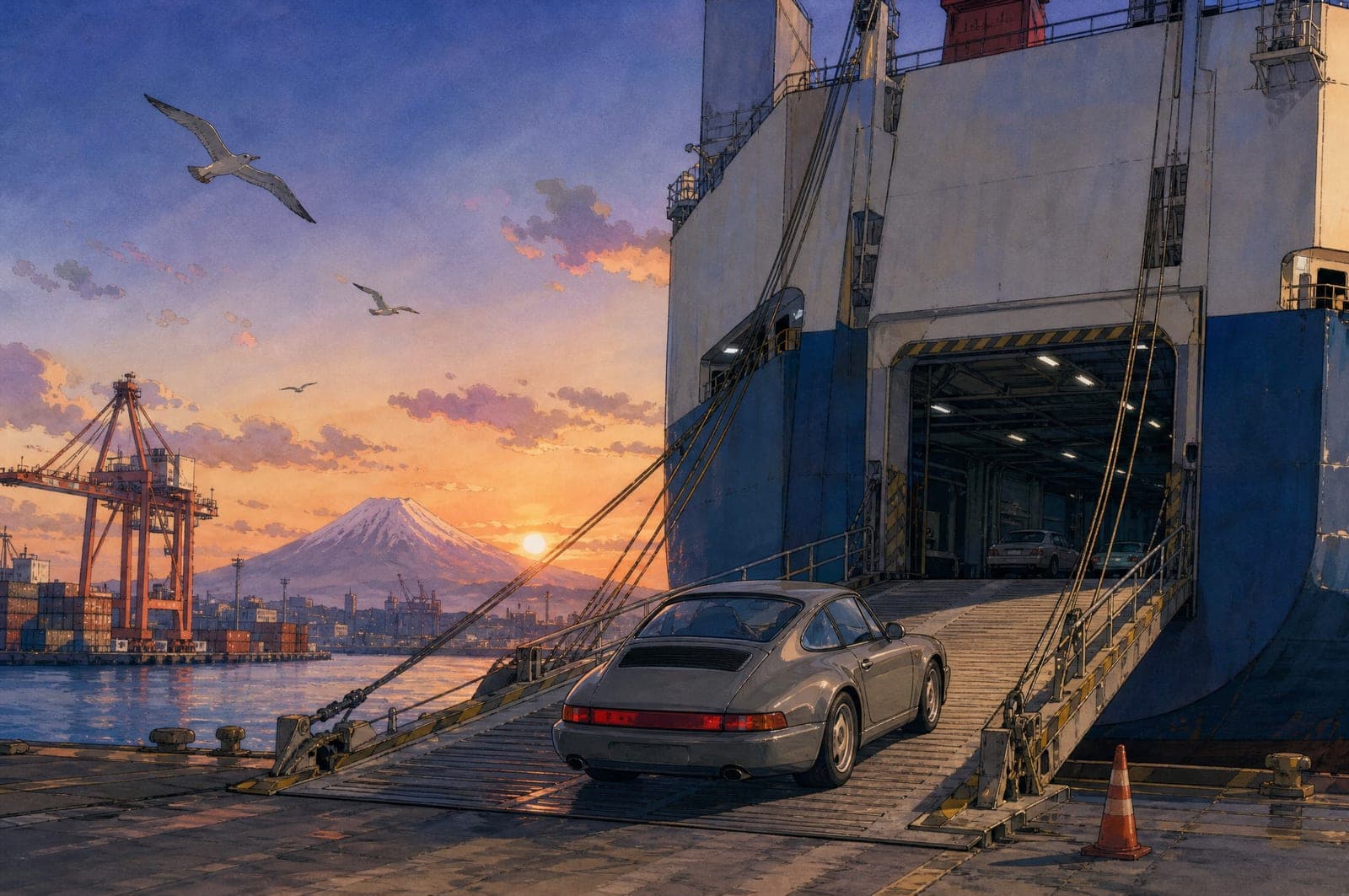
Roll-on roll-off (RoRo)
The car is driven onto a vessel designed to carry vehicles, lashed down on a deck and driven off at the destination port. It needs to be driveable and is shipped empty: nothing loose may travel inside. Loading is straightforward, which usually makes RoRo the simpler and often the lower-cost choice for one car on a route where vehicle carriers sail regularly.
Container
The car is loaded into a steel container, secured with lashings and blocks, and the container is sealed until it is opened at the destination. A container can carry one car or several, and it can carry parts, wheels or accessories alongside the car. It suits cars that cannot be driven, cars with items travelling with them, dealers moving several cars together, and routes where a container service is the practical option. The cost is per container, so consolidation, sharing a container between cars, is what brings the price per car down.
What affects suitability and cost
- Whether the car runs and drives. RoRo needs a driveable car; a container does not.
- How many cars are travelling. One car points to RoRo; several cars, or cars bought across different sales, can be held and shipped together in a container.
- Size and weight. Freight is priced on the space the car takes. Larger and heavier cars cost more on either method.
- Extra items. Parts or accessories can only travel in a container.
- The route and the destination port. Which services sail to your port, how often, and how the port handles each method. The country guide covers arrival for your destination.
- Timing. Waiting to fill a shared container saves money but adds time; a RoRo sailing may leave sooner.
We recommend a method for each car on these points and explain the reasoning. Where both methods work, the choice is yours.
What the shipping stage covers
After the car is acquired, a separate invoice covers freight and loading: port handling in Japan, loading on the chosen method (including securing inside a container) and the ocean freight to your port. Inland transport within Japan and export preparation (de-registration, the export certificate and the export declaration) are their own lines in the quotation, and what happens after the car is discharged at your port is a destination cost. What is and is not included for your car is itemised in the quote; see Understanding Costs for every cost line and which are paid at destination instead.
When arrangements are confirmed
Nothing is booked until the car is yours and the shipping invoice is settled. At booking we confirm the method, the vessel and the expected sailing. Before that point, any sailing date you are given is an estimate based on the services that usually run; after it, the date is the shipping line’s schedule, which can still move.
Estimates are not guarantees
Sailing and arrival dates come from the shipping line and are estimates. Vessels are delayed, schedules change, ports become congested and seasonal demand fills sailings. We pass on each change as soon as we know of it, and we never present a transit time as a guarantee. If a date matters to you, say so when you buy so the method and booking can take it into account.
Insurance
The scope of cover for the car in transit, and whether it is included, optional or arranged by you, is confirmed in your quote before the shipment is booked. Ask us if you want it explained before you buy.
How you are kept updated
You hear from us at the points that matter: when the shipment is booked, when the car has sailed, and when it is due to arrive, with the documents your destination needs sent as they are issued. If the schedule changes, you hear about that too. The buying process shows where shipping sits among the stages, and your country guide explains what happens once the car is at the port.

See the whole journey
Shipping is one stage of the buying process. The process page shows every stage in Japan and the destination stages for your country.