

Why Rindo
Your eyes and ears in Japan.
The listing starts the conversation. We investigate the details, pursue checks and inspections, and explain what we find before you commit.
How we review what is available
Every assessment starts with the information the seller or auction has already provided. We read all of it, not the headline grade.
The report, line by line
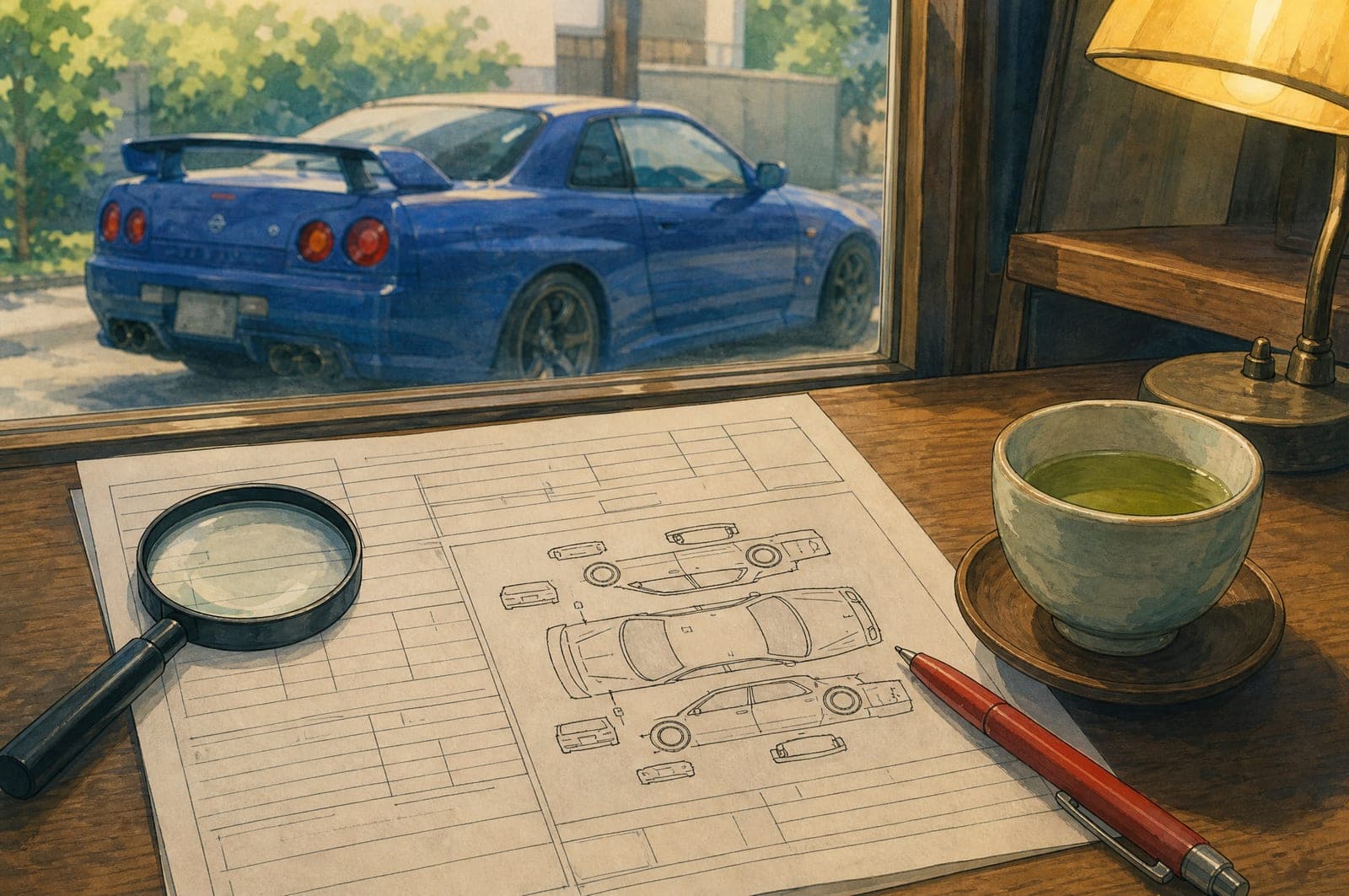
Grade, recorded mileage, equipment, the damage diagram and the inspector’s handwritten notes, translated and explained rather than summarised to a number.
The photographs, closely
Panel alignment, paint consistency, tyre and wear patterns, interior condition and what the photographs avoid showing as much as what they show.
The listing as a whole
Whether the mileage, the age, the equipment and the condition described make sense together, and what we want to ask about before going further.
Look beyond the grade
Checks beyond the auction sheet
The inspector had minutes with the car. We take the time the report could not.
Questions to the auction or seller
Specific points the report leaves open: a noise, a warning light, a repair mark, a missing record. We ask, and we tell you what came back and what did not.
Extra photographs where allowed
Where the auction or seller permits, additional photographs of the areas that matter for that car: sills, arches, underside, engine bay, chassis plates.
Consistency checks
Cross-checking the report against the photographs and the listing details, so a tidy sheet does not pass unchallenged when the pictures tell a different story.
Physical inspections, where available
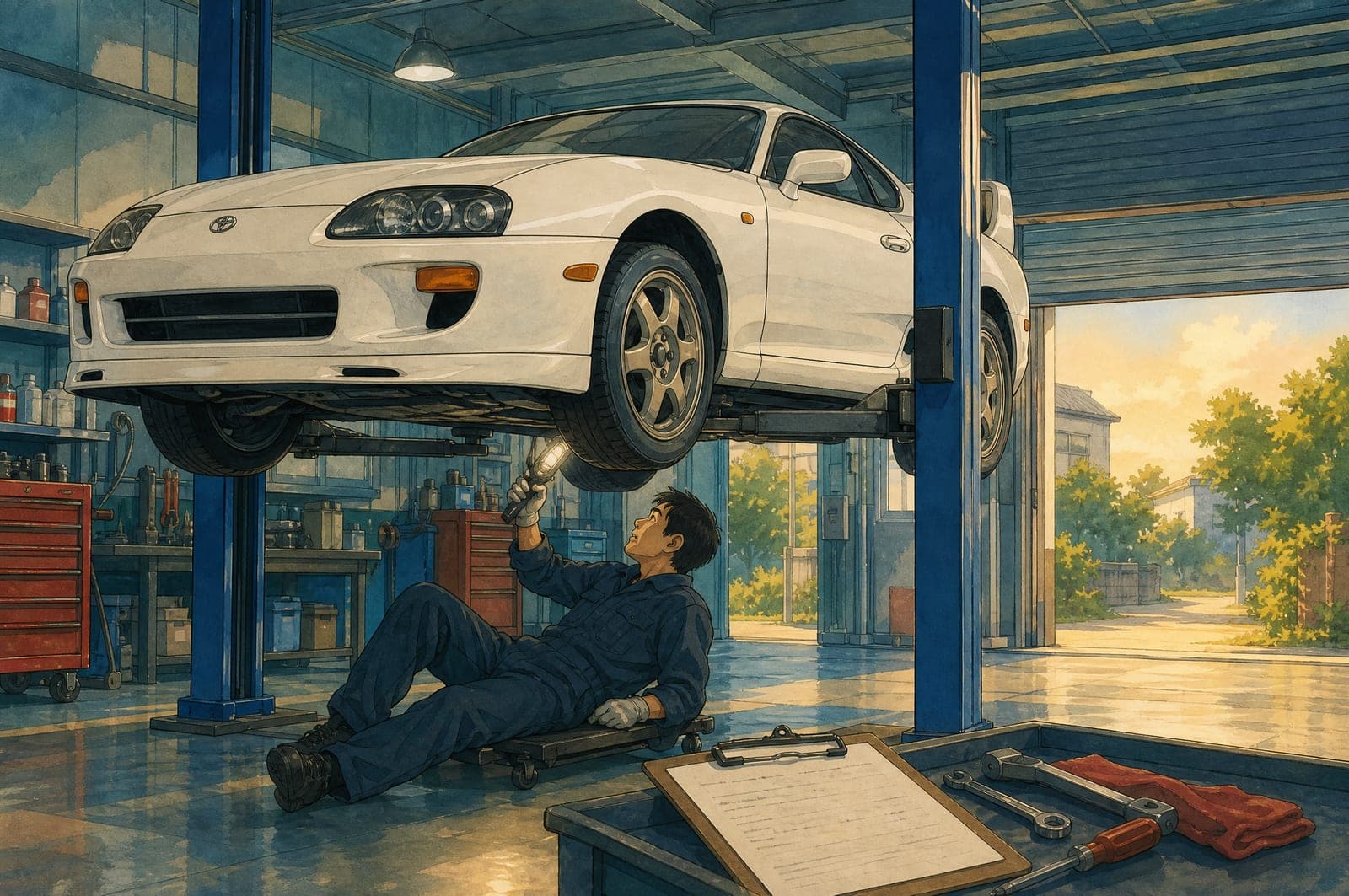
Where the auction or seller allows it and the sale date leaves time, we arrange for the car to be looked at in person before you commit: a closer visual check of panels, paint, underside where visible, interior and engine bay, and a cold start where permitted. The findings come back to you with photographs and a short written report.
Each report states who carried out the check, when, and what it covered. Inspections are not all the same: what was possible for one car at one auction may not be possible for another, and the report says so. Where we cannot arrange an inspection, we tell you before you decide, not after.
Inspections are an optional service with a cost, confirmed with you before anything is booked.
In person
Arranged around the sale
Timing against the auction date decides what is possible. Ask early on any car you are serious about.
Ask about a car →Model-specific knowledge and questions
A good assessment asks the questions an experienced owner of that model would ask. Known weak points, the service items that matter at a given age or mileage, the signs of a car that has been modified and returned to standard, and the originality details that affect value for a collector.
We bring that knowledge to each car we assess and, where we do not have it, we say so and find it before advising you. Specialist questions are put to the auction or seller in Japanese, and the answers come back to you in plain English.
What we are not saying
- Not every listing in the portal has been inspected. Assessment happens on the cars you shortlist and ask us about.
- No two inspections are identical. Access, timing and the auction’s rules decide the scope, and each report records it.
- No assessment guarantees a fault-free car. Findings are informed opinions on the day; they reduce the unknowns, they do not remove them.
Auction, dealer and sourced cars
The approach is the same. The access, and therefore what we can check, differs.
Auction vehicles
The auction house’s report and photographs are the starting evidence. Access to the car before the sale depends on the auction’s rules and the time available, so what we can add varies from lot to lot.
Stock cars
A dealer or seller has the car on site, so there is usually more to see and more time to ask. We confirm availability first, then review the condition information held and arrange further checks where they add something.
Sourced vehicles
A dedicated search can reach dealers, private sellers and auctions. Each candidate comes with our assessment and a cost estimate; locating a car is never a guarantee of its condition.
Reporting what we found
You receive our findings in writing before you authorise a bid or approve a purchase. The report covers what we reviewed, what we asked and what came back, what any inspection found, and what could not be checked and why. Limitations are part of the report, not a footnote.
Recommending whether to proceed
We close with a view: proceed, proceed with a lower ceiling, ask one more question first, or walk away. It is a recommendation, not a decision. The ceiling and the instruction are always yours, and we will say plainly when we think a car is not the one.
Before you buy, and after
Two different jobs. The first informs your decision; the second prepares the car you have already bought.
Before you commit
Pre-purchase assessment
- Review of the report, photographs and listing
- Questions to the auction or seller
- Further checks and inspection where available
- Written findings, limitations and a recommendation
After acquisition
Checks once the car is ours to handle
- A fuller workshop inspection can be arranged where useful
- Findings inform repairs or preparation before shipping
- They set expectations for arrival; they cannot change the purchase
- Destination inspections, where required, are compliance checks, not condition reports
Where this fits
Find a car
Auctions
Search Japan’s auctions in Rindo Portal, shortlist a car and ask us to assess it.
Explore the auctions →
How to buy
The buying process
Where the assessment sits in the journey from free registration to the car on your drive.
See the process →Learn with us
Understanding auction sheets
Read the report yourself: the main fields, the notes and the damage diagram.
Read the guide →Found a car worth a closer look?
Send us the listing. We will tell you what we can check, what it would cost and how long it takes before the sale.