

Learn with us
Clear explanations, without the jargon.
The terms you will meet on auction sheets, in quotes, in shipping documents and at the port, each explained in a sentence or two. Where a term deserves more, the entry links to the guide that covers it.
A
- Auction house
- A Japanese company that runs vehicle auctions for accredited members. Each house has its own inspection sheet, grading conventions and rules. How Japanese auctions work →
- Auction sheet
- The auction house’s inspection report for a lot: vehicle details, grades, a damage diagram and the inspector’s comments. Understanding Auction Sheets →
B
- Bill of lading (B/L)
- The shipping line’s receipt for the car and the document used to release it at the port of discharge. Export Documents →
- Buyer’s fee
- The fee an auction house charges the buyer on top of the hammer price. Understanding Costs →
C
- Compliance / approval
- Any test, inspection or approval your country requires before an imported car can be registered. What applies depends on the destination and the vehicle. Country Import Guide →
- Consolidation
- Shipping several cars together in one container, or holding cars bought at different sales so they travel on one booking. Shipping Methods →
- Container shipping
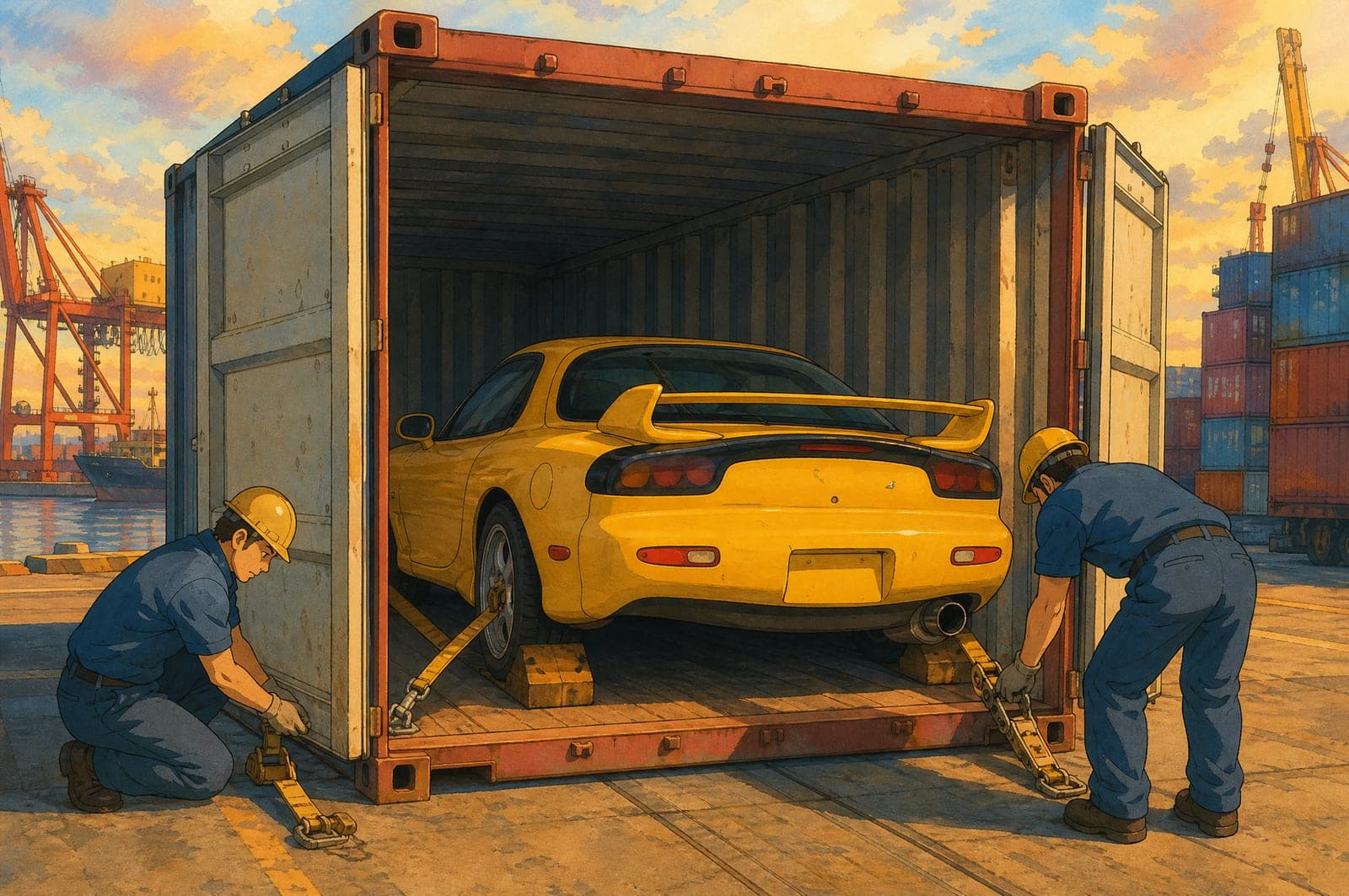
- The car is loaded and secured inside a sealed container, alone or with other vehicles, for the voyage. Shipping Methods →
- Customs clearance
- The import declaration made when the car arrives, and the payment of any duty and tax, before the car is released from the port. Country Import Guide →
D
- Damage diagram
- The outline of the car on an auction sheet where the inspector places letter codes for scratches, dents, repairs and corrosion. Auction Grades & Damage Markings →
- De-registration
- Cancelling a car’s Japanese registration so it can be exported. The export certificate is issued at this point. Export Documents →
- Dedicated Car Sourcing
- Rindo’s service for a specific brief: rare, classic or unusual cars searched for you, reviewed and bought only on your written approval. Dedicated Car Sourcing →
- Deposit
- A payment that enables complete auction access and bidding in Rindo Portal. The amount and exact terms are given before you pay. Being introduced in stages. Buying Process →
- Duty
- Import tax charged by the destination country on the car. The rate and the basis are set by your country’s rules. Country Import Guide →
E
- Export certificate
- The Japanese document issued on de-registration, recording the car’s identity and registration history. Supplied with an English translation. Export Documents →
G
- Grade
- The auction house’s condition summary: an overall grade plus interior and exterior grades. The same grade does not mean the same condition at every house. Auction Grades & Damage Markings →
H
- Hammer price
- The winning bid at auction, before the buyer’s fee and every other cost. Understanding Costs →
I
- Inland transport
- Moving the car within Japan, from the auction house or seller to the yard or port. Understanding Costs →
L
- Landed cost
- The total cost of the car delivered to you: purchase, fees, shipping, duty, tax and local charges. Understanding Costs →
- Lot
- A single car offered at auction, identified by its lot number on the sale day. How Japanese auctions work →
M
- Maximum bid
- The highest hammer price you authorise for a lot, in writing. The bid placed through Rindo never exceeds it. Auctions →
N
- Negotiation (after auction)
- Some houses let a buyer make an offer on a lot that did not reach its reserve. Not every house or seller takes part. How Japanese auctions work →
P
- Port of discharge
- The port in your country where the car is unloaded from the vessel. Named on the bill of lading. Shipping Methods →
- Pre-shipment inspection
- An inspection some destination countries require before export, carried out in Japan by an approved body. Whether it applies depends on your country. Export Documents →
R
- Registration
- Registering the imported car with your national authority so it can be used on the road, after clearance and any required approval. Country Import Guide →
- Repair history
- A note on an auction sheet, often shown as grade R or RA, that the car has had repairs to its body structure rather than only cosmetic work. Auction Grades & Damage Markings →
- Reserve
- The seller’s minimum acceptable price. A lot that does not reach it is not sold at the hammer. How Japanese auctions work →
- Rindo Portal
- The customer portal. The customer portal: free to register, with a case-by-case deposit opening complete listings and bidding. Register →
- Roll-on roll-off (RoRo)
- The car is driven onto the vessel, secured on a deck and driven off at the destination, rather than loaded in a container. Shipping Methods →
S
- Shaken
- Japan’s periodic roadworthiness inspection and certificate. An auction sheet notes whether it is current; it has no bearing on registration in your country. Understanding Auction Sheets →
- Stock Cars
- Cars available now from dealers and sellers in Japan, bought at an agreed price rather than at auction. Stock Cars →
V
- VAT
- Value added tax charged on the import in countries that apply it. The rate and what it is calculated on are set by the destination. Country Import Guide →
A term we have missed?
Tell us and we will add it. Questions about a specific purchase are answered directly.